A First Match on a Wet Day: Follow Territory
Follow territory in a rainy rugby match by tracking kicks, touch and restarts, so field position becomes a clear story rather than a blur of action.
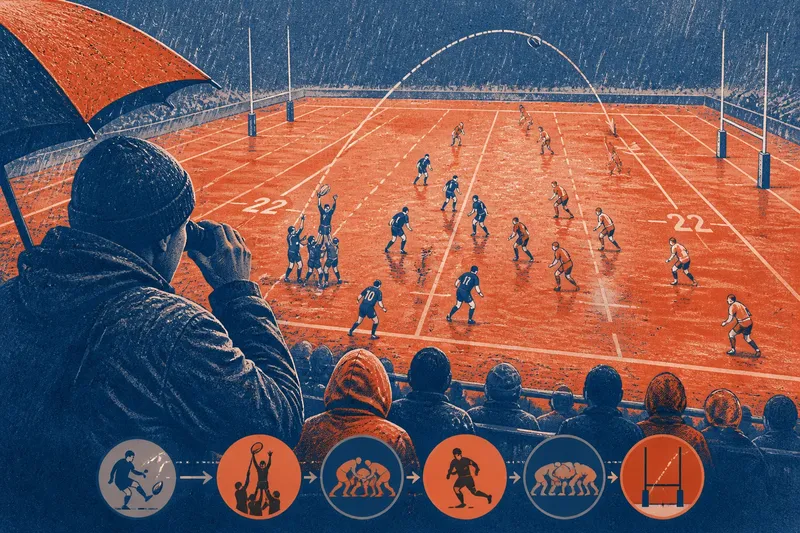
In a rainy rugby match, follow territory to see why one team kicks away the ball while another keeps it. The important clue is not simply who has possession, but where the next contest is likely to happen. A kick can surrender the ball and still move the game into a more favourable part of the field.
Territory is the match’s changing map
Think of the pitch as a long table: possession is the plate in front of a team, while territory is the space it has managed to move towards. The team with the ball can attack near its own goal or carry play towards the far end; those situations ask very different questions of both sides.
To orient yourself, locate the halfway line, the two 22-metre lines and each goal line. You do not need to memorise every marking. Just notice whether play is near the middle, inside one team’s 22, or pressing towards the other team’s goal. That rough map is enough to follow a shift in pressure.
On a wet day, the ball may be kicked more often, but the kick itself is only the start of the story. Watch where it lands, which side reaches it, and what happens next. A long kick that gives the opposition possession can still force them to begin their next attack far from your team’s goal.
Read each kick by its destination
A kick out of hand can serve different purposes. A team may send the ball into touch to gain ground, kick it downfield for an opponent to chase, or send it high so players can contest the catch. The shape of the kick matters less than the next location and the restart that follows.
When the ball goes into touch, look for the lineout. The throw gives both teams a chance to compete for possession, but territory has already moved: play will restart at the place where the ball crossed the touchline. A team may prefer that trade if the new lineout is much farther from its own goal.
In rugby union, a kick from inside the kicker’s own 22 can reach touch directly and still allow the lineout to be formed where the ball crossed the touchline, provided the ball was not carried back into the 22 by a player on the kicking team. The qualification matters: if a team carries the ball back into its own 22 and then kicks directly into touch, the lineout is generally brought back to where the ball was kicked. For a first-time viewer, note both the kick’s starting point and how the ball entered the 22; the landing spot alone does not tell the whole story.
A kick that stays in the field creates a different picture. The receiving team may gather it and counter-attack, kick it on, or carry it into contact. Trace the ball’s route with your eyes, then find the new carrier. If possession changes, note whether the new side has space in front of it or is trapped close to its own goal.
Touch and restarts show where pressure settles
Touch is not merely a boundary. It often tells you which team has chosen the next place of contest. After a kick into touch, the lineout forms beside the point where the ball went out; after a penalty kick to touch, the resulting lineout can give the kicking team both territory and a throw-in, depending on the laws governing that kick.
Scrums and penalty decisions can also reset the map. A scrum usually restarts play near the infringement, while a penalty may allow a team to kick for touch and move the next contest forward. Watch the referee’s signal, then look to the spot where play will resume. The restart location is often more revealing than the preceding pause.
Rain can make a sequence look messy: a kick may skid, a catch may spill, and the ball may be carried back towards the danger area. Resist the urge to decide what the whole passage means from one awkward bounce. Wait for the next stable position—such as a lineout, scrum or settled attack—and compare it with where the passage began.
Track territory without losing the action
Choose one team to follow for a few phases. Notice where it receives the ball, whether it carries or kicks, and where the next restart takes place. Then switch attention to the other team. This small routine makes the match easier to read without requiring you to identify every player or know every law.
- Check the halfway line as your reference point; if play is near it, watch which side moves the next contest beyond it, or keep using the nearest 22-metre line as your marker.
- Check whether a team starts possession close to its own goal; if it does, watch for a kick or carry that relieves pressure, or note how the defence closes space if it cannot advance.
- For each kick, check where it lands and who gets the next chance; if the receiving team has room, follow its counter-attack, or watch whether the kicking team’s chase limits that space.
- When the ball reaches touch, check the lineout position and which side throws in; if the throw belongs to the opposition, watch how the kicking team contests the lineout, or note whether it sets its defence for the next phase.
- After a penalty or scrum, check the restart point against the previous contest; if it has shifted towards the far goal, track the pressure there, or watch whether the opposing side moves play back towards halfway.
- At the next settled attack, check whether the carrier has room to advance; if space is open, follow the support runners, or if pressure is immediate, watch for a pass, kick or contact that changes the picture.
Say you are watching an invented match: Blue has the ball just beyond halfway, and Red has carried it back into its own 22 before Blue regains possession. Blue kicks directly into touch. The lineout is generally brought back to where Blue kicked, rather than being awarded deep in Red’s half; the observable trade-off is that Blue has chosen a touch restart but has not gained the distance the landing point might suggest. If, instead, Red had not carried the ball back into its 22 and Blue’s kick came from inside Blue’s own 22, the ball could reach touch directly with the lineout at the crossing point, subject to the applicable law and match circumstances.
What should you watch when a kick goes into touch?
Does the kicking team keep the throw-in?
Not automatically. A penalty kick to touch can give the kicking side the lineout throw, while other kicks usually leave the throw to the opposition; the circumstances of the kick matter.
Why would a team kick away the ball?
It may trade possession for a better starting position, or try to make the receiving side play under pressure. Judge the choice by where the next contest forms, not by the fact that the kick was made.
What does a kick that stays in the field tell me?
It leaves the receiving team a chance to carry, counter-attack or kick again. Follow who gathers the ball and whether they can move forward before the other side closes space.
How can I tell whether territory has changed?
Compare the restart or settled position with the place where the passage began. A lineout, scrum or penalty close to the far goal is a clear shift, even if the team that gained ground did not have the ball for much of the sequence.
The next restart completes the story
At your first wet match, let territory be the thread connecting kicks, touch and restarts. The ball may change hands several times, but the question stays manageable: where will play begin next, and which team has to deal with that position? Keep following territory, and a messy-looking passage starts to read like a chain of choices about where to meet the next contest.