The Laws Before the Name: Rugby’s Early Split
Rugby’s early split took shape through shared rules and organised play, showing how school football customs became a distinct code with its own identity.
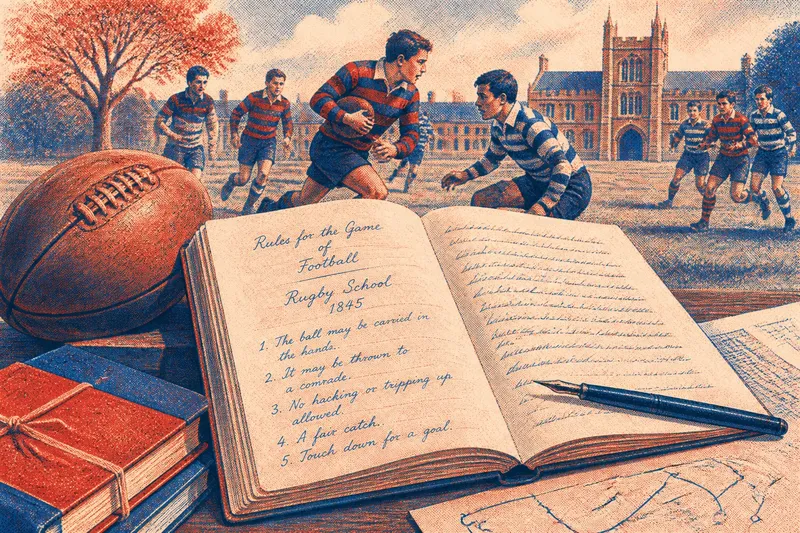
Rugby’s early split became visible in 1845, when pupils at Rugby School wrote down rules for the football they played. That date anchors a longer story: schools had their own versions of football, and a written code helped one tradition travel beyond its home ground.
Rugby School recorded its rules in 1845
Before a common code took hold, “football” could mean different things from one school to another. Local rules shaped whether players could handle or carry the ball, how play restarted and which forms of contact were allowed. A school’s pupils might understand those customs perfectly; visitors could not safely assume they knew them too.
In 1845, Rugby School pupils produced a written set of rules for their game. The document gives the history a concrete point of reference, but it did not instantly standardise football across Britain. Other schools and clubs still had their own traditions, and agreement beyond Rugby required further choices.
A written code works a little like a shared map: it lets people set out from different places while agreeing on the route. In football, the “route” meant deciding what counted as legal play and how a match should proceed when customs clashed.
Shared laws made matches between schools easier to arrange
Written rules gave organisers and captains something specific to agree on before a fixture. They could settle which code applied, then use its wording to guide play and handle disputes. This did not erase local habits; it made a match possible without asking one side to guess what the other considered fair.
Agreement could also change the character of the game. If a code permitted carrying the ball, that action became part of the contest; if it restricted an action, players had to adapt. Rules were therefore more than a record of custom. They helped determine which skills and decisions mattered on the field.
Football’s governing bodies marked different paths
In 1863, representatives met in London to form the Football Association and establish a code for association football. Rugby football followed a separate institutional path: the Rugby Football Union was founded in 1871. These named organisations and dates show that the split was not a single clean break at Rugby School. It developed as groups organised the games they wanted to play under distinct rules.
The resulting codes reflected different priorities about handling, running and kicking. The difference was not simply a matter of terminology. Once a group accepted one set of laws and organised fixtures around it, players learnt its permissions and limits through repeated play.
Dates clarify the sequence, but they do not make the change instantaneous. Schools and clubs adopted rules unevenly, and local preferences could linger. The distinct identities of association football and rugby football grew as organisations and teams kept using their respective codes.
The split involved ideas about what football should reward
Disagreement over individual laws could point to a deeper difference in taste. Should carrying and running with the ball be central? Should kicking take precedence? Which kinds of contact belong in a fair contest? A change to the code could favour one style of play over another.
That is why a debate about rules could become a debate about identity. If one group regarded an action as essential and another excluded it, the two sides were shaping different games, not merely choosing different words for the same custom.
How did rugby’s early split take shape?
Was rugby created in one decisive moment?
No single event accounts for rugby’s development from school football traditions. The 1845 rules at Rugby School are an important written landmark, while later organisations and fixtures helped establish distinct codes.
What happened in 1863?
Representatives in London formed the Football Association and adopted laws for association football. Rugby football continued along a separate path, later marked by the Rugby Football Union’s foundation in 1871.
Why did written laws matter?
They gave teams a common reference when local customs differed. Organisers could agree on a code before play, and captains and officials could use it to interpret disputed actions.
Did every school adopt the same code at once?
No. Different schools and clubs retained preferences, and adoption was uneven. A code gained influence through organisations and teams choosing to use it in their matches.
A match agreement shows how the rules worked in practice
Imagine a school team accustomed to carrying the ball arranging a fixture with a club whose players expect a kicking-focused code. Before the match, the organisers compare the two written rule sets, choose the code that will govern the fixture and tell both captains which one applies. The school’s players then know whether carrying is permitted under that agreement; if the chosen code excludes it, they must adapt their play, while the club cannot appeal to its own custom instead. The observable result is a match governed by one stated set of rules rather than two competing assumptions.
For readers tracing rugby’s early split, the useful anchors are the Rugby School rules of 1845, the Football Association’s formation in 1863 and the Rugby Football Union’s foundation in 1871. Together, those dates show how a written school code became part of a broader separation between organised games. The name mattered, but the laws and the people who agreed to use them gave rugby its distinct shape.