Blindside or Openside Flanker: Two Different Jobs
Blindside or openside flanker roles make scrums easier to read and show how each back-rower’s position can shape movement in open play.
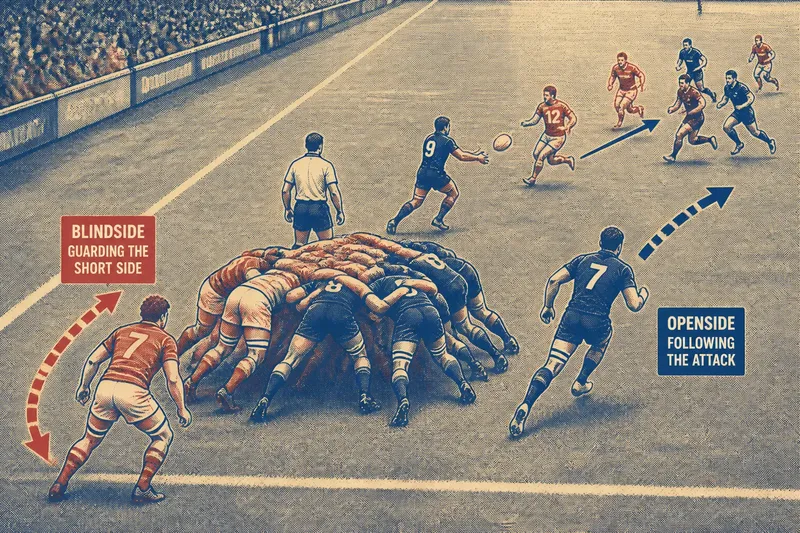
At a scrum near the left touchline, the flanker on the side with more field between the scrum and the far touchline is on the openside; the other is on the blindside. That is the clearest starting point for reading blindside or openside flanker roles, but it does not dictate what either player must do next. Their assignments depend on the team’s plan and the space around the next phase.
Use the scrum to identify the sides
In the usual positional description, each flanker binds on an outside edge of the scrum. The openside is the side with more room towards the far touchline; the blindside is the side with less. These labels describe the field around that scrum, not permanent player identities.
Teams may have players who regularly pack on a particular side, and commentators may use “openside” or “blindside” to describe a player’s customary role. Those conventions can differ. To identify the sides at a specific scrum, check the scrum’s position relative to both touchlines rather than assuming the same player always occupies one label.
A high camera angle makes the comparison easier: find the two touchlines, then look at the space on either side of the scrum. Think of the labels as directions on a road sign. They tell you where a player is positioned, not whether that player is naturally quicker, larger or more aggressive.
Track the flankers’ first movements after the scrum
One flanker may move towards the developing attack or the next breakdown while the other protects a channel or remains connected to the defensive line. That division of labour is a tactical choice, not a fixed rule attached to the labels. The same player may have a different assignment at a later scrum or phase.
Neither flanker owns every breakdown. A player may be delayed by traffic, required to defend a runner or positioned to support a later phase. The other can arrive first if the ball goes their way or the team’s shape calls for it. Look across several phases to spot a pattern instead of treating one arrival as proof of a permanent job.
Say a team has a scrum on the right side of the pitch and plans to move the ball left. The coach’s plan, in this invented situation, asks the openside to follow the pass towards the next breakdown while the blindside protects the short side before joining the attack. Watch where each player goes after the ball leaves the scrum; the observable result is whether the intended attacking support and defensive cover are both in place, not whether one player always arrives first.
Read the short side before judging a quiet blindside
The short side is the narrower space between the scrum or breakdown and the nearby touchline. An opponent may use it for a close carry or a short pass, so a flanker who stays near that area may be guarding an immediate route rather than waiting to join the next contest.
A blindside can also carry in a tight channel, support the scrum-half or move into another part of the team’s shape. The assignment varies with the situation. Do not assume that the player must always stay wide, remain beside the forwards or charge into the first breakdown.
To make sense of a quiet spell, note where the nearest opposition attackers are and whether the flanker shifts once the ball has moved past them. If the player holds the edge while an opponent is close, that may indicate a defensive responsibility; if the threat moves away, watch whether the flanker joins the next phase or takes up another position.
Follow the roles through a sequence of play
Open play makes the contrast easier to see when you follow each decision in order. Start at the scrum, locate the two sides, then track the flankers as the ball moves. Note whether each player supports the carrier, approaches a breakdown, guards the short side or stays connected to the defensive line. Compare those choices across the next phases, keeping in mind that a new scrum or a change in attack can alter the picture.
For example, imagine a broadcast shows the ball move away from a scrum while one flanker stays near the touchline and the other follows the carrier. If the short side still has an opposition runner in it, the first player’s position may protect that space; once the runner is covered and the ball moves on, the player may be free to rejoin the line. The sequence gives a clearer reading than the starting position alone.
What should you look for in open play?
Does the openside always chase the ball?
No. A team may ask the openside to defend a channel, track a runner or hold position for a later phase. Watch the player’s response to the team’s shape rather than expecting an appearance at every breakdown.
Is the blindside usually the bigger flanker?
Some teams may use a powerful carrier or lineout option in that role; others may favour different strengths. Size alone does not identify a player’s assignment, so use the scrum setup and movement in open play as better clues.
Can flankers switch sides during a match?
A team can change which player packs on each side, and a player’s responsibilities can shift as play develops. The positional labels still describe the space around the scrum, so check the setup rather than relying only on a familiar name.
What does each flanker’s first movement tell you?
It can suggest whether the player is supporting the attack, covering the short side or maintaining the defensive line. Treat it as a clue, then follow the next phase to see whether the movement fits a repeated team pattern.
Use a simple viewing checklist
- Check which touchline is nearer the scrum; if the scrum is close to one sideline, compare the remaining space on both sides, then label the wider side openside and the narrower side blindside.
- Check whether the broadcast angle shows both touchlines; if it does, use the field landmarks to identify the sides, but if it does not, wait for a clearer view rather than guessing.
- Check where each flanker moves as the ball leaves the scrum; if one follows the carrier, note the support or contest they may be seeking, but if one holds position, watch which space or runner they are covering.
- Check whether an opponent is threatening the short side; if a runner remains there, assess whether the nearby flanker is guarding that route, but if the threat has moved away, follow the player’s next movement for a new assignment.
- Check who reaches the next breakdown across several phases; if the same player repeatedly arrives, treat that as a possible team pattern, but if arrivals vary, avoid assigning the role from one isolated moment.
- Check whether a new scrum changes the field position; if it does, identify the sides again from the touchlines, but if the player’s customary label differs from the actual setup, distinguish the usual role from the position at that scrum.
Blindside or openside flanker roles become easier to read when the scrum is treated as a starting map rather than a complete job description. The most useful question is not only which side a player occupies, but what space that player protects or supports as the ball moves. Watching that responsibility change from phase to phase reveals more than a stereotype about size or speed.