The Myth That Every Rugby Attack Should Go Wide
Rugby attack is not always stronger out wide. Learn when a direct line can fix defenders, use support and create a clearer route forward.
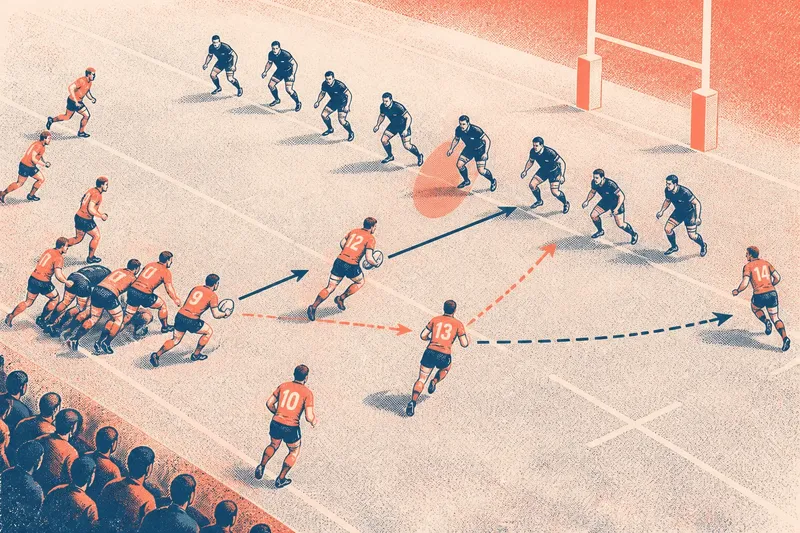
Rugby attack is not always stronger out wide: a direct line can be the better choice when defenders are already drifting towards the touchline. The point is not to avoid passing, but to make the defence answer a different question before the ball moves again.
Width gives an attack room to use, yet room alone does not create an opening. If defenders can slide across together, the ball may travel a long way without forcing anyone to change course. A straight runner, a short pass or a carry into a seam can interrupt that movement and give teammates a more useful next decision.
Why does going wide not always create space?
Going wide creates distance between attackers, but it does not automatically stretch the defence. Defenders can shuffle in the same direction, keep their spacing and wait for the outside player to run out of room. The attack has moved the ball; the defence has not necessarily been made to move in a meaningful way.
Imagine a hypothetical phase near halfway: the attacking team sends the ball through several pairs of hands, while the defenders slide neatly towards the far touchline. If the final receiver catches the ball with a defender still square in front and no inside support close by, the attack has gained width but not a clear route through. A runner aiming at the inside shoulder before the pass could make one defender turn inwards, leaving another to decide whether to follow or protect the outside.
That is the difference between width as a shape and width as an opportunity. It becomes threatening when a defender has been held, beaten or forced to make a choice. Without that pressure, a wide pass can simply deliver the ball to a player with less room to manoeuvre.
When is a direct line the better attacking choice?
A direct line is useful when the attack can meet the defensive line with pace and support, especially if defenders are retreating, turning or leaving a seam between them. “Direct” need not mean a headlong charge into the strongest defender. It means threatening the space ahead rather than moving the ball sideways before the defence has been challenged.
A runner can angle at the inside shoulder of a defender, carry between two defenders, or take a short pass close to the gain line. The aim is to make the defender commit: step in, drift out, tackle the carrier or cover the runner outside. Once that choice is made, a second attacker may have a clearer route, whether the ball goes on, stays with the carrier or comes back inside.
Think of the attack as a row of chairs being shifted across a room: moving the whole row sideways is not the same as leaving a gap in it. A direct threat can make one defender step out of line, while a pass released at the right moment uses the opening that decision creates.
There is a limit. If the defensive line is set, close and connected, a direct carry may only put the ball carrier into heavy traffic. The useful question is not “Should we always go straight?” but “Can this runner make a defender change position, and is there support close enough to use the result?”
How do field position and support change the decision?
Field position affects what the attack can reasonably pursue. Near the sideline, there is less room to continue outwards, so a carry back towards the middle or a short inside option may preserve more choices. Near the centre of the pitch, the attack can threaten either side, but that freedom is only valuable if players are positioned to act on it.
Closer to the opposition goal line, the defence has less ground to give up and can concentrate bodies in front of the ball. In that space, a direct line may still be valuable if it draws a defender or creates a close-range option, but repeated charges into a packed line can make the attack predictable. A pass behind the first line, a change of angle or a shift towards a less crowded channel may offer a better route.
Support is not simply the number of teammates visible. It matters where they are, how quickly they can arrive and what they can do if the first carry is stopped. A close support runner can take a short pass or help the attack continue through contact; a player positioned wider may be better placed to receive a pass after the defence has narrowed.
Picture a hypothetical attack just inside the opposition half. The first receiver sees defenders drifting outwards and a teammate running close inside. If the receiver carries at the seam and draws the nearest defender, the inside runner can take a short pass or the ball can go on to the outside player now facing a less settled line. The useful outcome is not assumed to be a break: it is that the defence has had to respond to a threat in more than one direction.
How can you tell whether the defence is vulnerable inside or outside?
Watch the defenders rather than counting passes. If their shoulders and feet keep turning towards the touchline, the attack may be able to threaten back towards the middle. If defenders are bunching close around the ball, space may be available farther out—but only if the pass can arrive before they recover their spacing.
Look for a defender who is stepping forward while teammates retreat, a gap between two defenders, or an outside defender who has begun drifting before the ball carrier commits. Those are clues, not instructions: a second defender may be ready to cover, and the apparent gap may close as the ball moves. The attack should read the next defender as well as the first one.
Also notice whether the receiver catches the ball standing still or moving onto it. A wide player receiving a pass while stationary may have little time to beat a defender who has already advanced. A direct runner arriving at pace can make that defender act sooner, but if the pass is late or the runner is isolated, the advantage disappears.
What questions help you read the choice during a match?
Does a direct carry mean the attack has abandoned width?
No. A direct carry can prepare a later pass by drawing defenders towards the ball. The width remains useful if teammates are ready to receive when the defence narrows or turns.
Should the ball always go to the player furthest from the ruck?
No. The furthest player may be well covered, while a closer runner may have a better angle or arrive with more momentum. Follow the defenders’ reactions rather than treating distance as a measure of opportunity.
What does “fixing a defender” mean?
It means making a defender commit to the carrier or a particular line, so that defender cannot freely cover another attacker. The effect may be subtle: a defender takes a step in, and a teammate outside gains a fraction more room to receive.
When can a direct line become a poor choice?
It is a poor choice when the defensive line is connected, the carrier has no nearby support, or the run takes the attack into traffic without making anyone choose. In that situation, changing the angle or moving the ball to a less crowded area may keep more options alive.
What should a viewer watch after the first carry?
Follow what the carry makes the defence do. Does a defender leave the line to tackle? Does another step in to cover? Do outside defenders stop drifting, or do they keep sliding together? These reactions reveal whether the attack has changed the picture, even if the carrier is stopped and the ball does not immediately reach the edge.
Then check where the support is. A teammate arriving close can help the attack continue, while a runner held wider may be the next option if defenders have been drawn in. If neither is in position, the direct carry may have used up the attack’s momentum rather than creating a useful next phase.
Rugby attack is best read as a sequence of choices, not a race to the touchline. When a direct line makes a defender commit and support is ready to use the response, width can become more dangerous afterwards. That is why the most telling moment may be the first step a defender takes towards the ball, not the last pass across the field.